
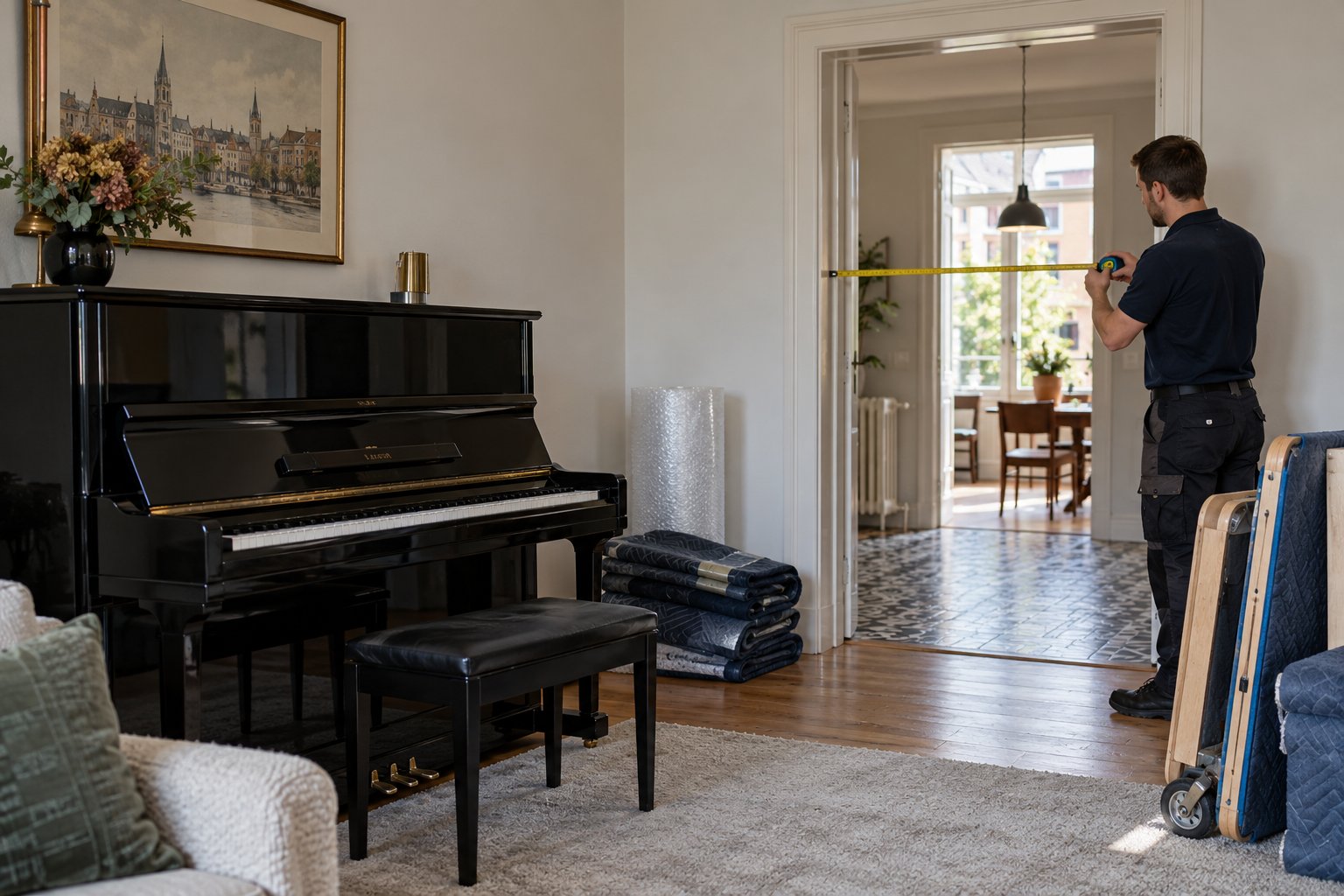
The word piano alone is insufficient for preparing transport. Shape, reference, current installation and routes at both addresses help the professional assess the task. A clear file supports focused questions and identification of further evaluation needs. It does not replace a visit where conditions require one. Gather the following details before discussing arrangements, without moving or dismantling the instrument to measure it. The aim is a description of the real situation rather than a handling plan improvised by the owner.
1. Identify the instrument and exact reference
Explain whether it is upright, grand, digital or another configuration. The cited Yamaha resources show that instrument families have different forms. Add brand and reference from available documents or accessible identification. An overview photograph completes the description. Avoid only giving an approximate name that may cover several sizes within a range. The reference should identify the actual instrument rather than a model remembered from an earlier purchase conversation.
Report additional equipment with known information. Mention the bench, accessories and components travelling separately. Do not search for a plate or number by tilting the instrument or opening a section you do not know how to handle. Send the question with existing photographs so the professional can determine an appropriate way to obtain missing details. Uncertainty can be recorded without creating an unnecessary movement merely to complete the initial request.
2. Provide dimensions and documented weight
Record dimensions accessible without improvised handling and look for official specifications matching the reference. Separate verified measurements, manufacturer data and estimates. For weight, identifying missing information is better than quoting another piano’s figure. A visually similar instrument may have different characteristics. Keep the file tied to the item actually entrusted to transport so the professional can see which data are reliable and which still need confirmation before planning.
Describe dimensions in the current configuration and identify parts whose treatment for travel is unknown. The professional decides which additional information is needed. Weight alone does not determine team numbers or equipment. The task also depends on route, levels, openings and instrument-specific assessment. Data support evaluation rather than authorising a personal handling attempt. Do not turn a broad internet weight estimate into instructions for helpers before the actual situation has been examined.
3. Show the complete collection route
Photograph the current position and route outside: doors, turns, landings, steps and any lift. Provide useful opening dimensions and known distances. Include access from the vehicle’s actual intended stopping point. A floor number in an address does not explain private internal stairs, changes of level within the home or the journey from the piano room to the main entrance. Describe those sections separately so they can be connected during assessment.
Explain how the instrument was installed if known and report subsequent changes. A partition, door or renovated floor may affect the route. That history does not guarantee that an old method remains possible. It helps identify constraints and questions to check before the service. Do not remove building components to recreate an earlier passage without suitable assessment and arrangements. The file should explain past access without presenting it as proof of present feasibility.
4. Describe delivery just as precisely
Document arrival independently of departure. Provide access, levels and space around the final position. A sufficiently large living room does not establish passage from the street. An outside option, if considered, needs specific assessment of openings, installation and conditions. A window alone does not secure that solution. Keep possible routes identified as options for professional evaluation rather than instructions that assume equipment can be installed merely because an opening is visible.
Identify key holders, building rules and access or parking procedures needing confirmation. Keep the final position available at the agreed stage. If renovation continues, describe actual conditions rather than an intended but unfinished layout. The professional needs to connect the instrument with an accessible destination and the necessary permissions and contacts for the selected operation. Changes after assessment should be reported while the plan can still be reviewed before the instrument arrives.
5. Clarify scope and responsibility
Ask explicitly which operations can be accepted for your instrument and conditions. Transport, particular preparation, protection and installation need confirmed scope. Do not assume an ordinary furniture service automatically includes a piano without assessment. Where a specialist or other provider is required, coordinate discussion and attendance before arranging dependent tasks. Each person should know which part they handle and what must be ready before their own intervention can start.
Report known condition, features and concerns requiring examination. Retain useful documents and clarify observation, follow-up and applicable cover arrangements without assuming a particular guarantee. A prepared question list is more useful than a general promise of no risk. Each answer should concern the actual instrument, route and agreed service. Keep confirmed conditions with the quotation information so the attending contact does not need to reconstruct them from memory during the move.
6. Prepare the day and suitable follow-up
Clear circulation according to received instructions and keep unrelated people outside working areas. Do not try moving the piano closer to the door to advance preparation without professional agreement. Appoint a contact familiar with the file and final position. Communicate last-minute changes before another operation, especially where placement or an unavailable room is involved. The professional’s assessment needs to reflect the location actually available rather than a plan nobody has checked since preparation.
At arrival, review destination and useful observations with those responsible. For maintenance, tuning or adjustments after movement, ask the technician or manufacturer according to the instrument rather than applying a universal delay. Keep contacts and records accessible. A complete request connects characteristics, access and responsibilities into a coherent situation that can be examined and confirmed before the intervention. That clarity supports transport planning without turning general piano information into instructions for unassessed handling.
Your checklist
- Identify type, brand and reference.
- Separate official data and verified measurements.
- Photograph every passage at both addresses.
- Confirm scope, providers and conditions.
- Prepare final position and instrument-specific follow-up.
Frequently asked questions
Is upright piano enough information for a quotation?
Add reference, dimensions, documented weight where available and detailed routes. The professional may request a visit or further information before confirming arrangements.
Should I move the piano towards the entrance?
Do not move it for preparation without suitable instructions. Describe its position and let the professional assess the route and operations rather than making an unplanned attempt.
Should tuning be arranged after transport?
Ask the technician or manufacturer for advice suited to your instrument and movement conditions. Do not infer one timetable from the fact that a move occurred.
Sources and checks
- Yamaha — Identifier les types de pianos
- Yamaha — Documentation et entretien des pianos
- Jet Movers — Faire examiner les biens et les accès
Sources checked on 20 October 2026. Confirm current arrangements with the organisation concerned.
Plan your move with Jet Movers
Share your addresses, preferred date, belongings and access information. Jet Movers will clarify the services suitable for your project.


